

The Heen Granary
The main Granary, the first on the farmstead, was built in 1883. Later, a lean-to was built on the west side for farm machinery storage and also a small lean-to was built on the north side for the same purpose. The northside lean-to was later used as a garage. On the south side, a scraper and a team of horses were used to build a mound of dirt, or a ramp. At threshing time a wagon box (3′ x 3′ x 10′) filled with grain sacks was pulled up on the ramp. One man would lift the sacks over the box to an upstairs doorway. Another man would drag the sacks across the floor to a hole about 20″ x 20″, untie the sack and empty it into the bin below. This was back-breaking labor, especially in hot weather, which was usual for threshing time. Gunder Heen was among the very first to install a grain elevator, a new idea at the time. First a pit had to be dug just inside the granary door and lined with boards. Regular cement was not used at the time. Then, a cupola was built so that the conveyor belt with cups that carried the grain to the top could use gravity flow to the bins. This was powered by a long shaft and pulley that extended to the north side of the granary. When this was in progress, some neighbors commented that Gunder Heen was getting lazy. The old idea was “the harder the work, the greater the reward “, or maybe “the greater measure of the man”.
The use of gravity was key for unloading grain. The east side upstairs bin is a gravity flow bin. All of them have floor holes used for unloading grain. Grain spouts were used to channel grain into the correct bins. The grain pit was used with the elevator system to move grain from one floor to another. The driveshaft for the elevator was first powered by horses, later by electricity. When portable, exterior grain elevators came into use, the elevator machine was rolled up to the building on the east, using the east cupola window as the entrance to move the grain into the ready spouts. One of the serious risks and challenges to moving the metal grain elevator was rolling it up to the cupola without striking the nearby power lines. Pry bars were used at the base to gently angle the elevator into position just a few inches at a time. Electrical lines were later buried. When grain was removed from the granary, an external auger was used, with its base set at the center of the first floor. The grain was channeled into this area and put into an old tin bath tub from the house, and augered to the wagons outside. When grain was removed from bins by shoveling, as it often was for small loads, we created counting games to guess how many shovels full would be needed to make a load. The north upstairs bin is the only one with a window. To prevent the weight of the grain from breaking the glass, the lower half of the window was often replaced by a heavy metal sign discarded by Land ‘O Lakes.
The granary was shingled in the late 1940’s by Warren Heen and “Little Iver” Ellingboe. The scaffold collapsed beneath the two men and they fell to the ground. Iver broke his arm. The cedar shingles from their work lasted for 50 years, weathering to half their original thickness, but as red as new in the sheltered layers. Due to moss and moisture problems on the north, the cedar was replaced with look-alike asphalt (25 year durability).
Granaries and harvests produced lots of stories. Christopher G. Heen worked so hard and got so hot working in his granary one year that he got cold, the sign of heatstroke. During a harvest on this farm, the hired man (who had a hangover) got behind in his work in the granary. They went out to check on him and found him laid out in the grain with his head and feet sticking out.

Items of interest in the granary:
- Grain scale( 1 bushel of oats = 36 pounds, 1 bushel of corn=56 pounds, 1 bushel of wheat or soybeans= 60 pounds. A bushel is the unit of volume equal to 8 gallons of liquid.
- Grain sack stencil and loading spring
- Sets of grain cups, metal and chain
- Antique machinery, including hand corn planter
The building still gives clues to its unwritten history. The west lean-to has notched sills, showing how floor joists were anchored in the building. The lumber is rough-hewn and full dimension. The quality of this original lumber was excellent, as we happily discovered when the building was raised, revealing floor joists in near-mint condition, except for a spot of animal gnawing. Because the building was so closely interlinked with notched floor joists, repairs to the east sill at the front of the building had to be repaired not replaced. Also, structural gaps resulted from a cut through the long east sill wall when the grain pit was first installed. To correct this, the sill was pulled together with concrete and re-rod and lumber. The 1996 renovation included the excavation of the grain pit and formation of a new one in concrete.
The northeast foundation had been repaired earlier, as had the west lean-to. In 1969, the lean-to rock foundation was removed and a concrete foundation poured. In the rubble of the rocks, Warren Heen found a 7 shot revolver, Smith and Wesson 32 caliber, with one bullet rusted in the revolver. No explanation has ever been found for the presence of this gun.
The wall of the west lean-to has drop siding, not the lap siding found on the rest of the building. Square nails are found throughout the building. The wall studs are spaced the narrowest of any building on the farm because the granary had to be the strongest load-bearing structure. In 1967, an additional lean-to area was removed from the west side.
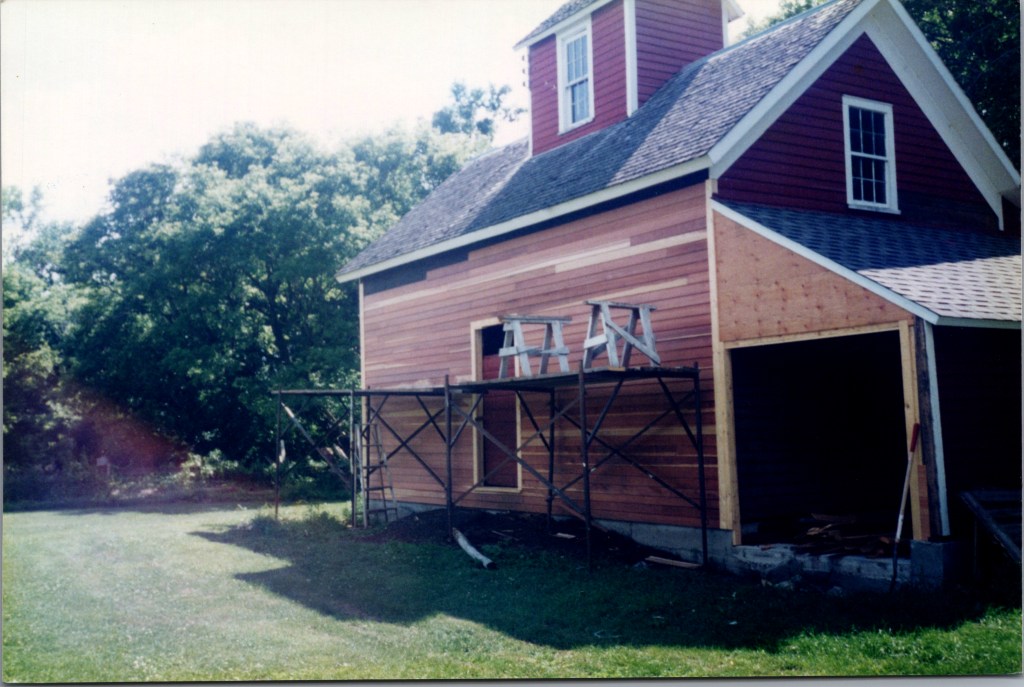
For several years prior to 1996, Carol, Linda and Les Heen researched and evaluated options to restore and repair the granary, which was sinking and pulling apart particularly in the southwest corner. By spring of 1996, the plan was ready and work began. The Theins of Clara City hydraulically raised the building four feet and rested it on wooden piers. The old stone foundation was pulled out by machine and by hand by Merlyn Ast and Menno Frerichs. Merlyn Ast and a crew built a series of concrete forms around the building’s outer walls, plus under the center walls, and the grain pit. Over a period of three weeks, concrete foundations were poured with an extra-wide footing extending two feet below ground.. The driveshaft for the elevator was encased in PVC pipe to keep it free-moving. New steel air shaft screens were fashioned and installed on the southeast and northeast corners by blacksmith Melvin Lorentson. Later in the summer, the building was lowered and concrete floor slabs were poured over the old dirt floors in the west and north areas for better use of the building and animal-proofing. Harlen Leese replaced the oldest siding on the east and south sides with cedar clapboard siding over plywood sheets. The west side drop siding was also replaced. In September we painted all the new siding. Harlen Leese shingled the cupola and east side in October. The roofline, thanks to the new foundation, is straight and the building has been pulled together successfully. New shingles on the north side were put on in 1995. The old door was removed from this lean-to and replaced by one large door, itself rescued from the old garage built in the early 1940’s. The only modern exterior item is a garage door on the south side for the lean-to. To preserve the historical appearance of the east side of the building, the electrical service entrance was moved to the north side.
Written by Warren Heen and Carol Heen



Designed by Mickey Reed